 |
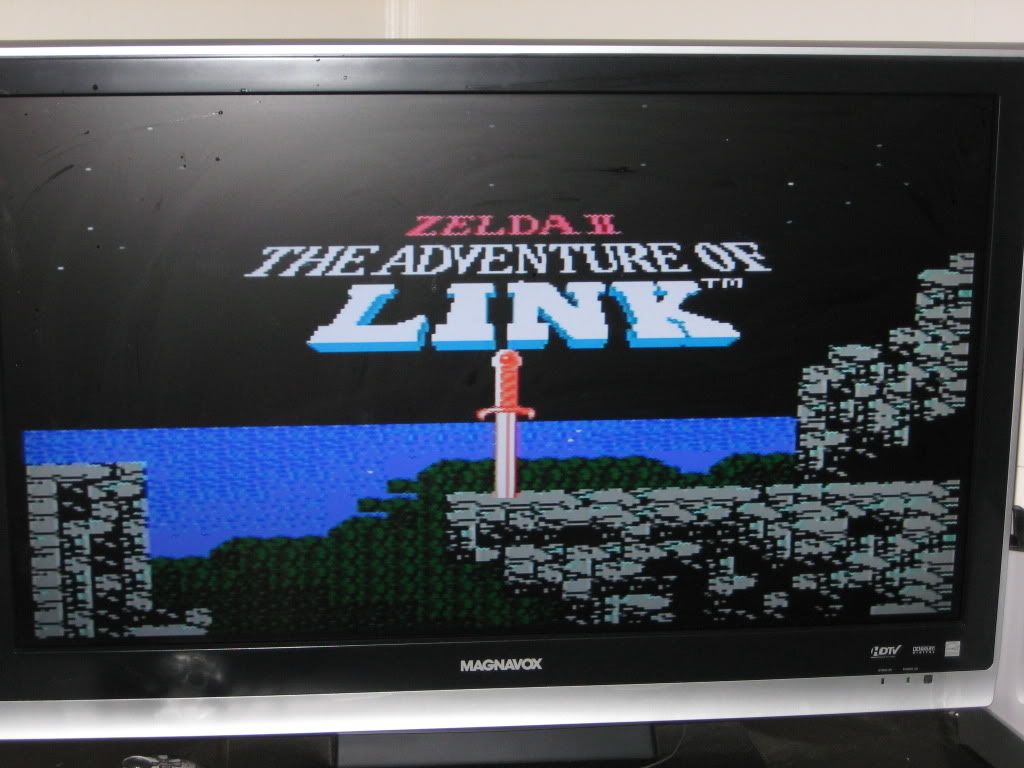
| Title Screen: The Adventure of Link |
The most interesting thing of note about Link's Adventure is that, chronologically, with the exception of the cel-shaded titles, though the game is in release order second; it is story-wise recognized as after Zelda I but before the cel-shades, making its story near the end. Most of the titles to come after explain or unveil things about Hyrule that happened previously.
Link's Adventure is far more action oriented than puzzle. It is not for the Zelda player who goes for puzzle-solving over action, which is one of the reasons it actually isn't one of my favorite titles, however, it does have its own unique charm to it and after you get into the system, the action isn't overtly difficult (just occassionally irritating, like any Zelda). Link goes from the traditional over-world exploration/dungeoneering system to a different one. While he still explores the overworld, he doesn't actually encounter his enemies directly on the overworld map. Instead, symbols representing encounters try to ambush him and when they touch him, he enters an encounter (kind of like DnD) and he enters a side-scrolling encounter. The dungeons are mapped much in the same way (side-scroll rather than overhead) adding a different dimension to the whole series. This depart from tradition probably upset gamers early on but it can be really fun. Also, Link has statistics to help him survive, much like in an RPG...making this Link even more unique. Many of these things never show up again in Zelda titles, but they were a fun change and helped to succeed in giving players a different kind of challenge instead of the same one with a different color and story (who wants that in a sequel, anyway).
So all this being said, let us begin the Adventure of Link and save Hyrule from evil's grasp once again. The story this time around is much more complicated, though much like Zelda I it is hidden from us for most of the game.
An evil wizard has locked Zelda in an eternal sleep, see. The protagonist of this game is the exact same Link as from Zelda I except now, instead of being a tween, he's a teenager, a bit more grown up and still as adventerous. This story reveals to us the nature of the name Zelda: the prince of this kingdom was seeking the Triforce and Zelda refused to reveal any information about it. The prince could only see his own greed and looked to the help of a wizard to help him get that which he needed. The wizard, however, was a conspirator and was looking to use the power of gold for himself to revive Ganondorf, the evil king we adventured long and hard to defeat last time around (and many times more in the future). The wizard tricks the prince, and puts Zelda into an unbreakable sleep: only the Triforce can help her. The prince decrees that all Princesses from that point forward are to be named "Zelda" in rememberance of this tragedy. One way or another, this older Link notices a birthmark appear on his hand (in the shape of the triforce) and seeks counsel from Impa, the hidden guide through Zelda I who sought him in that quest. Impa notes that the mark means that Link is the hero of time, fated to carry the Triforce of Courage, and reveals to him Zelda as well as the mystery behind the six palaces and the Great Palace: and that it is his destiny to journey through them to recover the Triforce of Courage.
This game is the first to introduce the Triforce of Courage and make the triforce a triplicite rather than duplicite entity. This now fully defines the triforce, as we do not see the three elements without one another again, as we did in the first game. In addition, this game also has you fully interacting with your world with NPCs and such, making the role-playing expereince of this RPG much deeper than that of its predecesor.
One of the major things to note about this game is its level of difficulty. The game's experience point system is quite wonky, and as well, the threshold of baddies/current level is always in favor of your opponents, meaning that Link has to be very clever and careful as he travels the Hylian landscape. Grinding is a huge part of the experience of this game, and as well as action over puzzle (though it does a nice job of combing both elements, it just focuses far more on action).

No comments:
Post a Comment